
Your Motorcycle Is Your First Piece of Camping Gear |
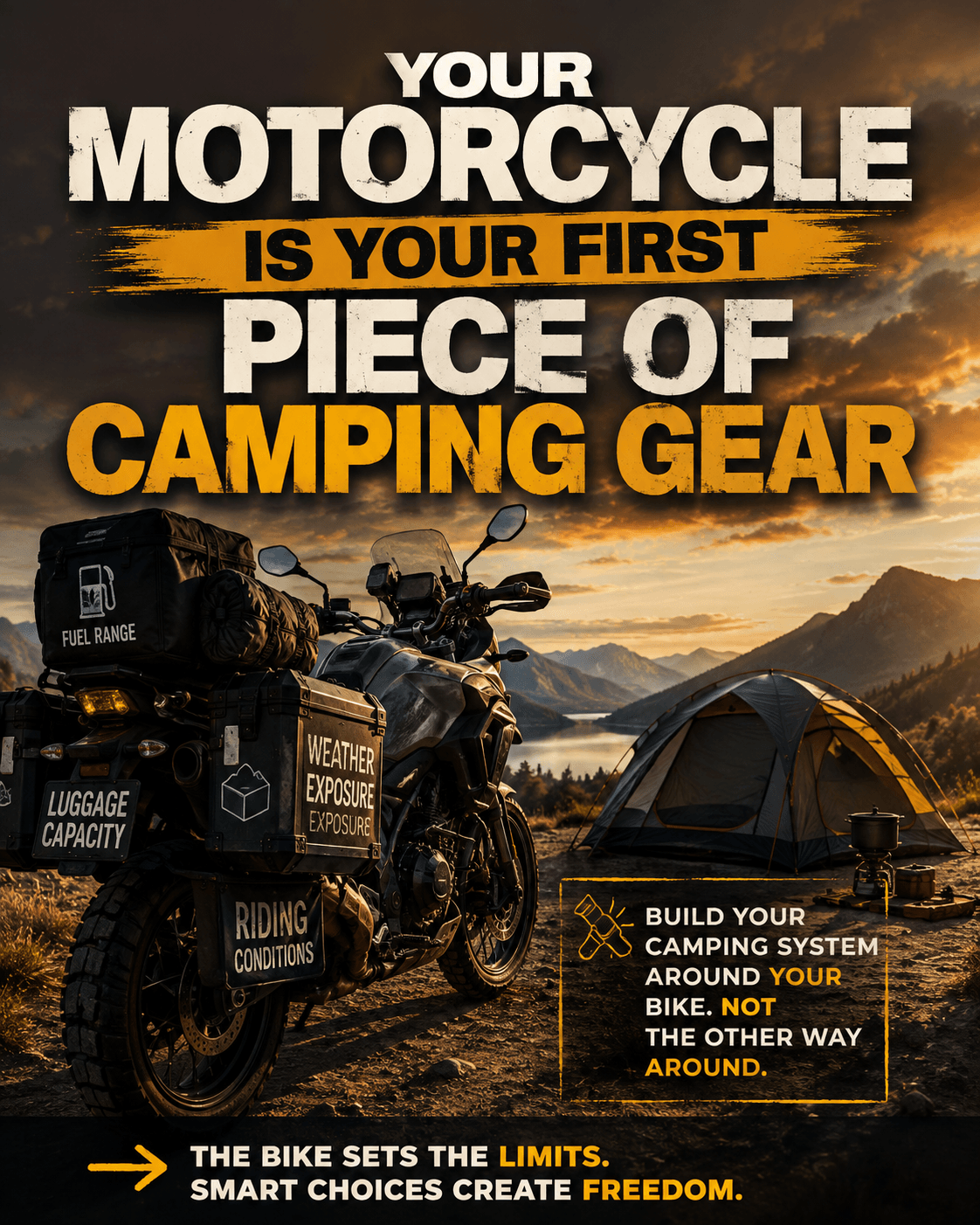
Your Motorcycle Is Your First Piece of Camping Gear
Most people start planning a moto-camping trip by thinking about what they need to take.
Tent. Sleeping bag. Sleeping mat. Stove. Food. Clothes. Water. Tools.
Then they look at the pile and ask the obvious question: “How am I going to fit all this on the bike?”
That question comes too late.
The motorcycle isn't simply the thing that gets you to the campsite. It's the foundation of the entire camping system. Its luggage capacity, fuel range, weather exposure, riding position, available mounting points, stability, and the conditions you're expecting to ride through should influence almost every camping decision you make. That's the part many new moto-campers miss.
They take a conventional camping setup and try to shrink it until it'll fit on a motorcycle. That's backwards.
A better approach is to start with the motorcycle and build the camping system around it.
The difference sounds subtle, but it changes how you make decisions.
Stop asking “What camping gear do I need?”
Imagine you've got a motorcycle with limited luggage space and you're planning a two-night trip. You find a comfortable three-season tent, a thick sleeping mat, a large sleeping bag, a compact camping chair, a stove, cookware, spare clothing and all the other things you'd normally associate with camping. Individually, every item makes sense.
Together, they might make a terrible motorcycle setup.
Why?
Because each item was chosen in isolation. The tent might be excellent but awkwardly shaped for your luggage. The sleeping bag might be wonderfully warm but take up a huge amount of space. The chair might only weigh a little, but perhaps it occupies an awkward corner that prevents you from carrying something more useful.
This is where the idea of the motorcycle as your first piece of camping gear becomes useful.
Before choosing equipment, understand the container you're working with.
How much usable luggage space do you actually have? Not the manufacturer's headline capacity. The practical space available once you account for the shape of the panniers, top box, dry bags, mounting systems and anything else that occupies room. Where can weight safely and conveniently be carried?
What needs to remain accessible during the ride?
What happens if you need waterproof clothing halfway through the journey?
Can you reach the tools without unpacking half the bike? Where will your tent go if everything else is wet? These aren't really camping questions. They're system-design questions. And once you see the motorcycle as part of the camping equipment, they become much easier to answer. There's an important distinction here:
A good piece of camping gear isn't necessarily gear that's good for moto-camping.
A normal camper can often carry something because there's room for it. A moto-camper has to account for volume, weight, shape, accessibility and how that item interacts with the motorcycle. That's why “small” isn't always the same as “motorcycle friendly.” A bulky item can be relatively light. A compact item can be surprisingly heavy. Two pieces of equipment might perform the same job but occupy completely different amounts of useful space. The real question isn't simply, “How much does it weigh?” It's:
“What does this item cost me in space, weight, access and riding practicality?”
That's a much better filter. Think in systems, not individual itemsHere's a practical way to test your setup. Take every major item you're planning to carry and consider it against four things:
Space. Weight. Access. Consequence.
Space asks whether the item fits efficiently. Weight asks where that weight is going and whether you're comfortable carrying it there.
Access asks whether you can get to it when you need it. Consequence asks what happens if conditions change, something gets wet, something breaks, or you realise you need the item unexpectedly.
That fourth question is particularly useful. Suppose your waterproof jacket is buried underneath your tent, sleeping bag and cooking equipment because you packed according to what fitted most neatly. At departure, the sky is clear. Two hours later, rain arrives. Technically, you've brought the jacket. Practically, you haven't.
You've created a system where having the equipment isn't enough. You also need access to it at the right moment. That's why motorcycle luggage shouldn't be packed simply as a storage puzzle. It should be packed according to how you'll actually use the equipment.
Think about the trip as a sequence. Ride. Arrive. Stop. Set up. Eat. Sleep. Wake. Pack. Ride again.
The best arrangement often becomes obvious when you think through that sequence.
The things you'll need during the ride should be accessible without dismantling the camping system. The things needed immediately on arrival shouldn't be buried underneath everything else. Wet or dirty equipment needs somewhere sensible to go without contaminating the rest of your kit.
You're not just packing a motorcycle. You're designing a temporary living system that has to survive movement. The motorcycle also determines the trip
This becomes even more important when you consider fuel and riding conditions.
A motorcycle with a modest fuel range creates different camping decisions from one with a much larger range.
If you're travelling through areas where fuel stops are frequent, your planning may be relatively straightforward. If you're heading somewhere more remote, fuel becomes part of the camping system. The same applies to weather.
A lightweight setup that works beautifully during a dry weekend may be less suitable when persistent rain is expected. A rider travelling through exposed roads in cold weather has different priorities from someone travelling a short distance on a warm summer evening. This doesn't mean you need specialist equipment for every imaginable condition.
It means your equipment should match the conditions you're actually asking it to handle.
That's an important difference.
A common mistake is buying equipment based on an imagined version of moto-camping rather than the trips you're realistically going to take.
Someone might buy an elaborate expedition-style setup because they dream of riding across remote landscapes, when their first several trips are actually going to be short weekends within a few hours of home.
There's nothing wrong with having ambitions.
But your first camping system should solve your real problems first. Consider a rider planning their first two-night trip.
They've bought a large tent because it feels more comfortable, a substantial chair because sitting on the ground doesn't appeal, multiple cooking pots because they want flexibility, several changes of clothes because they don't want to feel grubby, and a large collection of “just in case” items.
The bike is now packed to capacity. Instead of asking which item to remove, they might buy larger luggage.
That's the trap.
The luggage has become the solution to a packing problem that was actually caused by the camping system.
Now the extra capacity encourages more equipment. More equipment creates more weight. More weight affects the riding experience. The rider becomes more conscious of the load, the bike takes longer to unpack and repack, and the simplicity that attracted them to moto-camping starts disappearing. The problem wasn't that the motorcycle couldn't carry enough. The problem was that the camping setup wasn't designed around the motorcycle.
Use the “Bike First” TestBefore buying or packing anything, ask five questions:
What can my motorcycle comfortably carry? What conditions am I actually planning to ride and camp in? What needs to be accessible while I'm travelling? What needs to be accessible immediately when I arrive? If I remove this item, what genuine problem remains unsolved?
That last question is particularly powerful. Don't ask whether an item might be useful. Almost anything might be useful under the right circumstances. Ask what problem it solves and how likely that problem is to occur on this particular trip.
That distinction can dramatically change a packing decision. A spare layer might solve a realistic problem if you're expecting cold evenings.
Three spare layers may simply represent uncertainty disguised as preparation.
A basic repair kit makes sense because a mechanical problem can interrupt the entire trip.
Three different solutions to highly unlikely mechanical problems may simply consume valuable space.
The aim isn't to become obsessed with carrying as little as possible. Ultralight isn't automatically better.
The aim is to make every item earn its place. And sometimes the right decision will be to carry something larger or heavier because it solves an important problem particularly well.
That's perfectly compatible with the principle. The motorcycle sets the constraints. You decide what deserves to live inside those constraints. That is the key shift.
Don't build a camping kit and then try to make your motorcycle carry it. Build a camping system that makes sense for the motorcycle you're actually riding.
Once you start thinking this way, you'll notice something interesting. Your motorcycle begins telling you what kind of camper you can comfortably be.
Not because it limits your adventure, but because constraints force better decisions.
A smaller luggage setup encourages prioritisation. Limited fuel range encourages better route planning. Weather exposure encourages sensible clothing access. Limited space encourages equipment that performs more than one useful function.
The result isn't necessarily a minimalist camping setup. It's a deliberate one.
And that's a much more valuable goal. So before your next gear purchase, don't start with the question, “What do other campers carry?” Start beside the motorcycle. Look at the luggage. Think about the journey. Think about the weather.
Think about what you'll need while riding, what you'll need when you stop, and what you'll need when something doesn't go according to plan.
Then ask the most useful question of all:
“Does this piece of gear work with my motorcycle, or am I making my motorcycle work around it?”
That one question can save you a surprising amount of weight, money, frustration and unnecessary kit.
And once your camping equipment starts working with the bike instead of fighting it, the whole experience becomes simpler. That's when you're no longer just carrying camping gear on a motorcycle. You're actually moto-camping.
|
Try This With AI
Use the AI you're already using: ChatGPT, Claude, Gemini, Grok, Meta AI, Copilot, or another general-purpose AI assistant. Replace the example information inside the brackets with your own information, then copy and paste the complete prompt into your AI.
AI Prompt
|
0 Comments
Join the conversation
Be the first to comment
Share your thoughts above.